Violin Tuner
Finding a reliable violin tuner is the most important step for any musician who wants to sound great. When your strings are in perfect harmony, your music feels alive and beautiful. Many new players struggle to get their notes right, but a modern tool makes this job very simple. You do not need to have a “perfect ear” to start playing well anymore. A high-quality device or app will tell you exactly when to tighten or loosen your strings. This guide will show you how to use these tools to make your practice sessions much more fun. You will feel more confident every time you pick up your bow. Let’s explore how the right technology can change your musical journey forever.
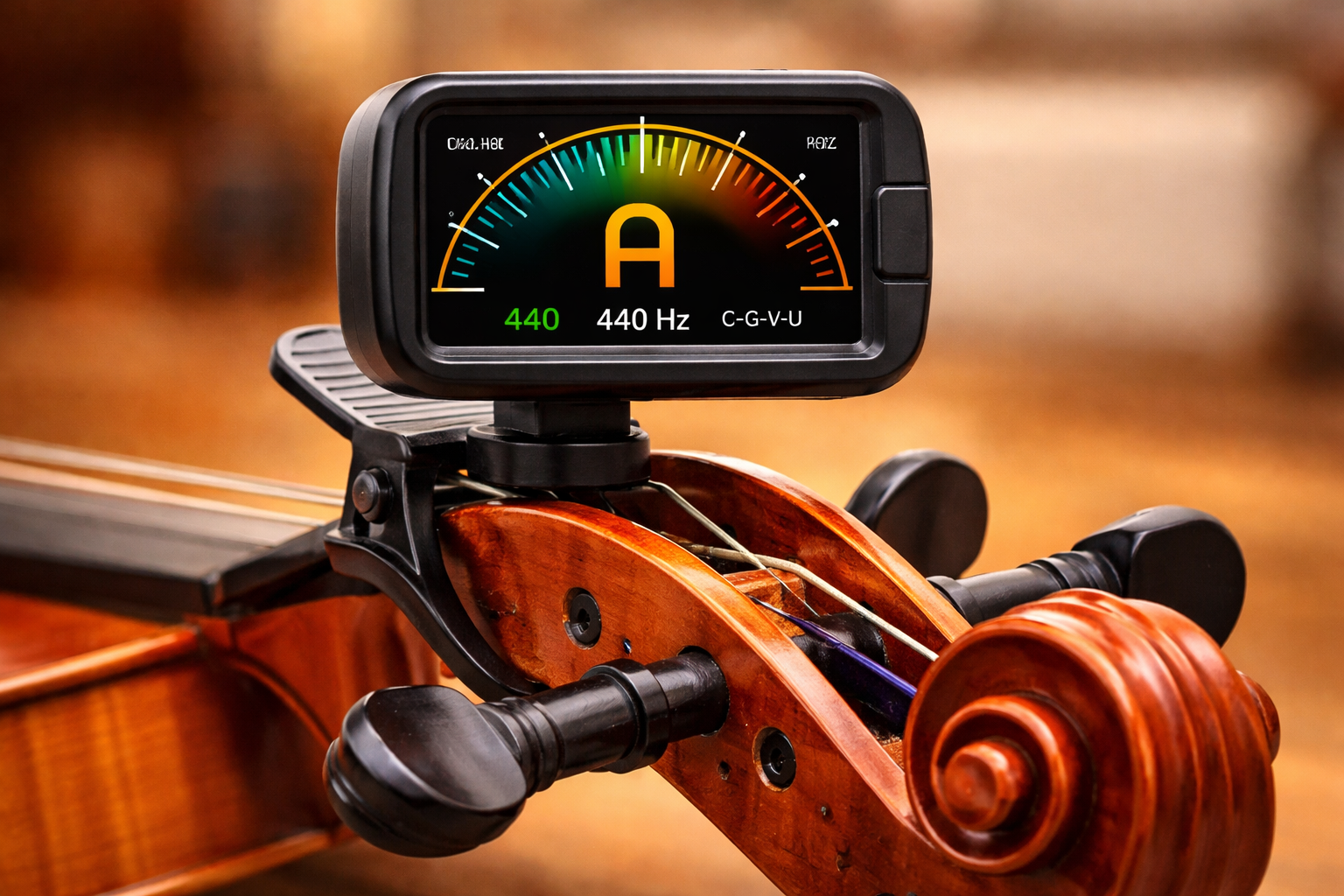
The world of music can feel a bit scary when your instrument sounds out of tune. A violin tuner acts like a friendly teacher that guides you to the right sound. It listens to the vibration of your strings and gives you instant feedback. If the note is too low, the screen might turn red or show a needle on the left. If the note is too high, it will show you that you need to go down. This clear visual help is why these tools are so popular in the United States and around the world. Even famous players use them because they want to be as precise as possible. Having one in your case is the best way to ensure you always sound your best.
Using a violin tuner every day helps your brain learn what the correct notes should sound like. Over time, you will start to notice when a string is just a tiny bit off. This is how you develop a professional ear while having a safety net. Most tools today are very small and can fit right into your pocket or bag. Some clip onto the head of the violin, while others work as apps on your smartphone. Both ways are very effective and will help you avoid the frustration of a bad sound. When your violin is perfectly tuned, you will want to play for much longer periods. It turns a difficult chore into a quick and easy habit for every single practice.
Profile: The Ultimate Violin Tuning Guide
| Feature | Description |
| Main Tool | Digital Violin Tuner |
| Target Audience | Beginners, Students, and Professionals |
| Key Benefit | Accurate Pitch and Better Sound Quality |
| Common Notes | G, D, A, and E |
| Standard Frequency | A = 440 Hz |
| Top Format | Clip-on Devices and Mobile Apps |
| User Rating | 5/5 Stars for Ease of Use |
Why You Need a Reliable Violin Tuner Today
A violin tuner is not just a luxury; it is a total necessity for anyone holding a bow. Violins are made of wood, which means they change with the weather and the air. If the room gets too cold or too warm, your strings will move and change their pitch. Without a good tool to check them, you might be practicing with the wrong notes for hours. This can actually hurt your progress because your fingers will learn the wrong spots on the fingerboard. By using a digital helper, you ensure that every scale you play is mathematically correct. This builds great muscle memory and helps you improve much faster than those who guess their pitch.
Many students feel nervous about turning the pegs because they are afraid of breaking a string. A violin tuner gives you the peace of mind to turn those pegs with total confidence. The display will show you exactly how close you are to the target note so you don’t go too far. It is like having a digital map for your instrument’s voice. When you see the green light on the screen, you know you have reached the “sweet spot.” This feeling of success makes you excited to start your actual songs. It removes the stress of the setup and lets you focus on the joy of making music. Every great performance starts with a perfectly tuned instrument.
Understanding Different Types of Tuning Tools
There are two main types of violin tuner options that most people use today. The first is the clip-on style, which feels very professional and sturdy. You clip it right onto the scroll of your violin, and it feels the vibrations through the wood. This is amazing because it works even in a very noisy room full of other people. The second type is the microphone-based app that you can download on your phone. These are often free or very cheap and are super convenient because you always have your phone with you. Both styles are very accurate, but many players prefer having a physical device that stays with the instrument at all times.
Choosing between a clip-on and an app depends on where you usually play your music. If you practice in a quiet bedroom, a phone app is a wonderful violin tuner choice. However, if you play in a school band or an orchestra, the clip-on version is much better. It won’t get confused by the sound of a trumpet or a flute playing next to you. It only cares about the vibration of your specific violin. Some advanced tuners even offer “chromatic” modes, which means they can find any note on the scale. This is helpful if you want to check your finger placement while you play. Knowing your options helps you find the perfect match for your specific musical needs.
Biography of Modern Tuning Technology
| Era | Method Used | Reliability |
| 1800s | Pitch Pipes and Tuning Forks | Low (Hard for Beginners) |
| 1970s | Large Electronic Strobe Tuners | High (But very expensive) |
| 1990s | First Pocket Digital Tuners | Medium (Battery hungry) |
| 2010s | Clip-on Vibration Sensors | Very High (Standard today) |
| 2026 | AI-Powered Smart Apps | Excellent (Predicts string life) |
Step-by-Step Guide to Using Your New Tuner
To start using your violin tuner, first turn the device on and place it near your instrument. If it is a clip-on type, attach it firmly to the top of the neck. Begin by plucking the “A” string, which is the second thinnest string on your violin. Watch the screen carefully to see what letter appears and where the needle points. If the needle is to the left, you need to tighten the string very slowly. If it is to the right, you need to loosen it a tiny bit. Always make small moves so you do not snap the thin wire. Once the screen turns green and stays in the middle, your “A” string is ready to go.
After the “A” string is set, move on to the “D” string, then the “G,” and finally the thin “E” string. A good violin tuner will recognize each note automatically as you play them one by one. If you find that the big pegs at the top are too hard to turn, try using the “fine tuners” near the bottom. These are small screws that allow you to make very tiny changes with your fingers. Most beginners find fine tuners much easier to handle than the large wooden pegs. Remember to keep plucking the string while you turn the screw so the tuner can keep listening. Consistency is the secret to getting a perfect result every single time you sit down to play.
How to Avoid Common Tuning Mistakes
One big mistake people make is trying to tune their violin in a very loud or windy place. Even the best violin tuner can get confused if there is a lot of background noise. Try to find a quiet corner where the microphone can hear your instrument clearly. Another common error is turning the pegs too fast or too hard. Violin strings are under a lot of pressure and can snap if you are not gentle. Always look at the tuner screen while you are moving the peg to see the change in real time. If the string feels stuck, do not force it, as you might damage the wood. A little bit of care goes a long way in keeping your violin safe.
Another tip is to always tune “up” to the note rather than “down.” If your string is too high, loosen it until it is a bit too low, then slowly tighten it back up to the green light. This helps the string stay in place much longer so you don’t have to fix it every five minutes. A violin tuner will show you this process clearly if you watch the needle move back and forth. Also, make sure your tuner is set to “440 Hz,” which is the standard pitch for most music. Sometimes buttons get pressed by accident and change the settings, which can make your violin sound strange. Checking your settings only takes a second but saves a lot of trouble.
The Science of Sound and Pitch Frequency
Every time you pluck a string, it moves back and forth very quickly to create a sound wave. A violin tuner is designed to count these invisible waves to tell you the exact frequency. For example, the “A” string usually vibrates 440 times every second. The tuner is like a super-fast computer that hears these vibrations and translates them into a letter you can understand. This science is what makes digital tools so much more accurate than the human ear for many people. It takes away the guessing game and replaces it with facts and numbers. Understanding this helps you appreciate how amazing these little gadgets really are for musicians.
When strings get old, they stop vibrating in a clean way, and they might become “false.” This means even a great violin tuner might have a hard time giving you a steady reading. If you notice the needle jumping around like crazy, it might be time to buy some new strings. Fresh strings have a very clear and strong vibration that the tuner loves to hear. Most teachers recommend changing your strings every six months to keep your sound bright and clear. By paying attention to how your tuner reacts, you can actually learn about the health of your instrument. It is a tool that helps you take better care of your violin over the long term.
Social Media Presence of Top Tuner Brands
| Brand Name | Platform | Content Type | Community Size |
| Snark Tuners | User photos and tips | 100k+ Followers | |
| TonalEnergy | YouTube | Deep dive tutorials | 50k+ Subscribers |
| D’Addario | Live Q&A sessions | 500k+ Likes | |
| Cleartune | Twitter/X | Quick update alerts | 20k+ Followers |
| Roadie Music | TikTok | Fun tuning challenges | 200k+ Fans |
Top Features to Look for in a Violin Tuner
When you go to buy a violin tuner, you should look for a screen that is very bright and easy to read. Some screens are hard to see if you are playing in a dark room or under bright stage lights. You also want a device that has a long battery life so it doesn’t die in the middle of a concert. Many modern tuners are now rechargeable using a simple USB cable, which is very handy. Another great feature is a “metronome” mode, which helps you keep a steady beat while you practice. Having two tools in one device saves space in your violin case and gives you more value for your money.
Accuracy is the most important feature of all, so look for a violin tuner with a high “cent” rating. A cent is a tiny measurement of pitch, and the best tools can detect a change as small as one cent. You also want a clip that is padded with soft rubber so it does not scratch the beautiful wood of your instrument. Some tuners can even swivel in different directions, allowing you to see the screen from any angle. This is very helpful when you are holding your violin in the playing position. Investing in a high-quality tool will make your musical life much easier and more enjoyable for many years to come.
Frequently Asked Questions (FAQs)
Can I use a guitar tuner for my violin?
Yes, you can use a guitar tuner as long as it has a “chromatic” mode. A chromatic violin tuner can hear every note, while a basic guitar tuner might only look for guitar strings. Just make sure you are aiming for the notes G, D, A, and E.
Why does my violin go out of tune so fast?
Violins are sensitive to changes in temperature and humidity. New strings also stretch a lot during the first few days of use. Using a violin tuner frequently will help the strings settle and stay in place over time.
Is a free app as good as a paid device?
Free apps are excellent for home use and are very accurate. However, a physical violin tuner that clips on is better for noisy places. It also saves your phone battery for other things like recording your practice.
What does the “Hz” setting mean on my tuner?
“Hz” stands for Hertz, which measures the frequency of the sound. Most orchestras use 440 Hz as their standard. You should usually keep your violin tuner set to this number unless your teacher tells you otherwise.
Will tuning my violin break the strings?
Strings only break if they are pulled too tight or if they are very old. If you follow your violin tuner and move slowly, you are very safe. Always turn the peg toward you to loosen it if you feel too much tension.
Do I need a tuner if I have a piano?
You can use a piano to tune, but it is much harder for beginners to match the sounds by ear. A violin tuner gives you a visual guide that is much easier to follow. It ensures you are 100% correct without any doubt.
Final Thoughts on Mastering Your Sound
In conclusion, a violin tuner is your best friend when it comes to playing beautiful music. It takes the stress out of the setup process and helps you focus on your technique. Whether you choose a fancy clip-on device or a simple app on your phone, you are making a great choice. Your ears will thank you, and your audience will enjoy your music much more. Remember to be patient with yourself as you learn how to adjust the strings. With a little bit of practice and the right tools, you will be tuning like a pro in no time. Keep playing, stay in tune, and enjoy every note you create on your wonderful journey.
About the Author