June birthstone
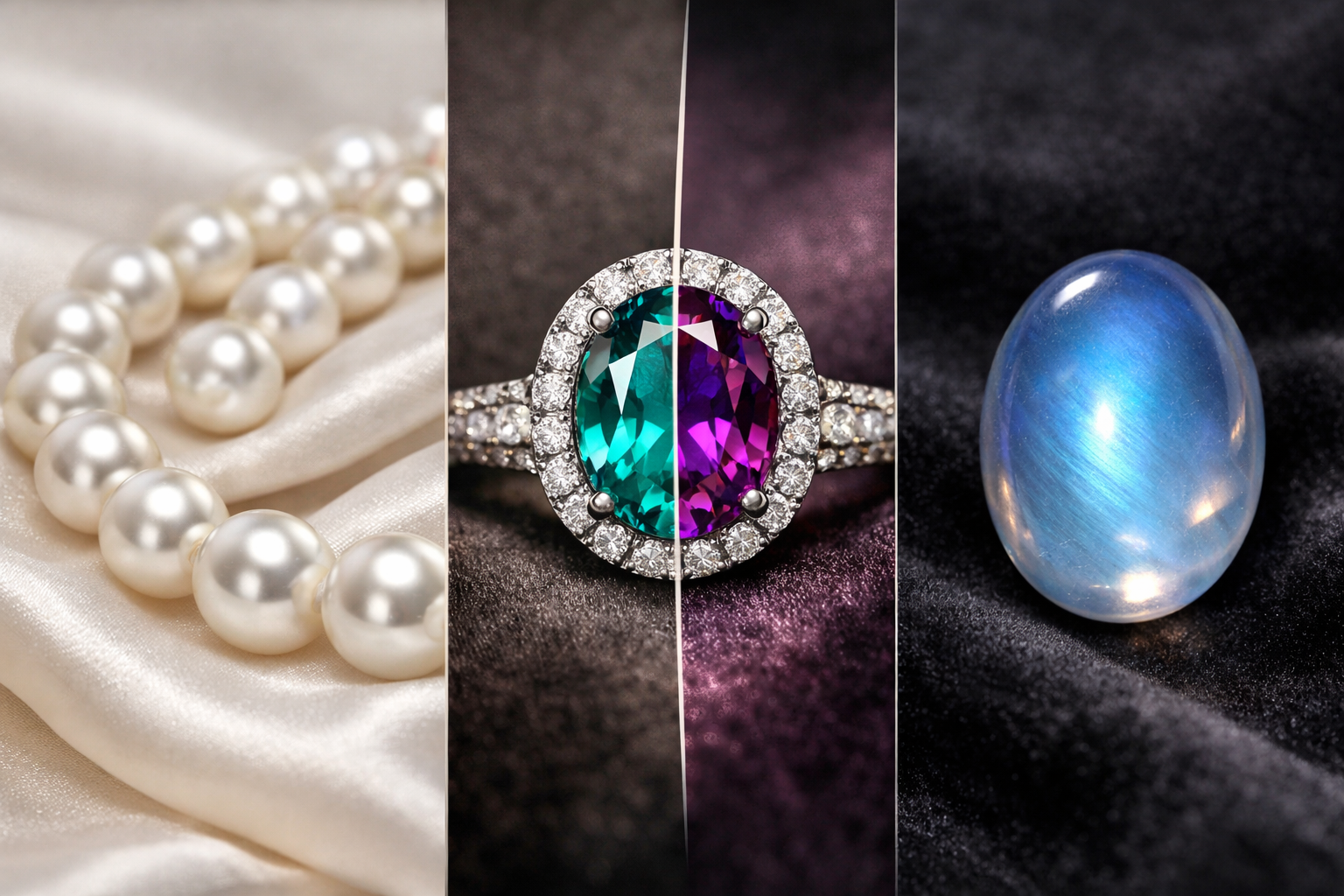
If you were born in June, you possess a rare “gemological privilege.” While most months are tethered to a single stone, June offers a diverse trio: the organic Pearl, the color-shifting Alexandrite, and the glowing Moonstone. This variety ensures that whether you prefer classic elegance, scientific marvels, or ethereal mystery, there is a June birthstone that fits your personal narrative.
Why Does June Have Three Birthstones?
It is a common point of confusion. Why does June get three choices while January is stuck with only Garnet? The answer lies in the evolution of the jewelry industry and the desire to provide consumers with options across different price points and aesthetics.
The 1912 Standardization
Before the 20th century, birthstone lists were disorganized and varied by country. In 1912, the American National Association of Jewelers (now Jewelers of America) met in Kansas City to create a standardized list. They named the Pearl and Moonstone as the official representatives for June. Both stones share a soft, milky glow that was highly fashionable during the Edwardian and Art Nouveau eras.
The 1952 Addition of Alexandrite
By the mid-20th century, the Jewelry Industry Council of America decided the list needed a modern update. Alexandrite—a stone discovered in the 1830s that had captured the world’s imagination with its dramatic color-changing properties—was added to the June lineup. This gave June babies a “modern” alternative that was significantly rarer and more durable than the traditional pearl.
The Timeless Pearl: The Queen of Gems
The pearl is unique in the world of gemstones because it is the only one created by a living creature. While diamonds and rubies are forged under the earth’s crust, pearls are grown inside the mantle of mollusks.
How Pearls Form: Natural vs. Cultured
A pearl begins as an accident. In nature, a microscopic irritant enters a mollusk’s shell. To protect itself, the creature secretes layers of a calcium carbonate substance called nacre. Over several years, these layers build up to create a pearl.
Today, natural pearls are incredibly rare and found almost exclusively in vintage jewelry or specialty auctions. Most pearls you see today are cultured. This doesn’t mean they are “fake”; it means a human technician carefully placed a small “bead” inside the mollusk to jumpstart the natural nacre-secreting process.
The Four Main Types of Cultured Pearls
If you are shopping for a June birthstone gift, you need to know which type of pearl you are looking at, as the price difference is massive:
- Freshwater Pearls: Grown in lakes and rivers, these are the most common and affordable. They come in a wide variety of shapes and pastel colors.
- Akoya Pearls: These are the classic white, perfectly round pearls most people picture. They are grown in Japanese and Chinese saltwaters and are prized for their brilliant, mirror-like luster.
- Tahitian Pearls: Often called “Black Pearls,” these are naturally dark (though rarely truly black). They often display stunning overtones of peacock green, silver, or purple.
- South Sea Pearls: The “Rolls Royce” of pearls. They are the largest and most expensive, typically found in white, silver, or deep gold.
The 7 Factors of Pearl Quality
When evaluating a pearl, look at these seven criteria used by experts:
- Luster: The most important factor. Is the reflection on the surface sharp or dull?
- Surface Quality: Are there visible pits, cracks, or bumps?
- Shape: Perfectly round is the most valuable, but “Baroque” (irregular) shapes are currently trending in modern jewelry.
- Color: Does it have a secondary “overtone” (like pink on a white pearl)?
- Nacre Thickness: This determines how long the pearl will last before the “skin” wears off.
- Size: Larger pearls take longer to grow and cost significantly more.
- Matching: How well do the pearls in a strand look together?
Pearl Care: The “Last On, First Off” Rule
Pearls are soft ($2.5–4.5$ Mohs). They are easily scratched by other jewelry and can be dissolved by the acids in your perfume, hairspray, and sweat. Always remember: Pearls should be the last thing you put on in the morning and the first thing you take off at night. Wipe them with a soft, damp cloth after wearing to remove oils.
Alexandrite: The Rare Color-Changing Wonder
If the pearl is about tradition, Alexandrite is about magic. Discovered in Russia’s Ural Mountains on the birthday of Tsar Alexander II, this stone is a variety of the mineral chrysoberyl.
The Science of “Emerald by Day, Ruby by Night”
Alexandrite is famous for its “chameleon” effect. In natural daylight, it appears a crisp, bluish-green. However, under incandescent light (like a candle or a yellow lightbulb), it shifts to a purplish-red.
This happens because of the way the stone absorbs light. It has a high concentration of chromium (the same element that makes emeralds green and rubies red). In Alexandrite, the chromium is balanced in a way that allows it to flip-flop between the two colors depending on the light source.
Spotting the Difference: Natural vs. Lab-Created
Natural Alexandrite is one of the rarest gemstones on Earth. High-quality specimens can cost upward of $30,000 per carat, making them more expensive than many diamonds.
Because of this rarity, most “Alexandrite” found in local jewelry stores is actually lab-grown. Lab-grown Alexandrite has the same chemical and physical properties as the natural stone but is created in a fraction of the time. While beautiful and durable ($8.5$ on the Mohs scale), it does not hold the same investment value as a stone pulled from the earth.
- Tip: If the color change is “too perfect” (shifting from bright blue to bright purple) and the price is under $1,000, it is almost certainly lab-created or a “simulant” (like color-change sapphire).
Moonstone: The Ethereal Traveler’s Stone
Moonstone is the most “mystical” of the June trio. It has been used in jewelry for centuries, notably by the Romans who believed the stone was formed from frozen rays of moonlight.
What is Adularescence?
The hallmark of a high-quality moonstone is adularescence. This is the glowing light that seems to float across the surface of the stone as you move it, much like moonlight shimmering on water. This isn’t a surface reflection; it’s caused by light scattering between microscopic layers of different minerals (orthoclase and albite) inside the stone.
The Truth About Rainbow Moonstone
There is a significant misconception in the market regarding “Rainbow Moonstone.” Mineralogically, Rainbow Moonstone is actually a variety of Labradorite, not true Moonstone.
- True Moonstone: Usually has a white or blue glow (schiller).
- Rainbow Moonstone: Displays a multi-colored, spectrum-like flash.While both are beautiful and belong to the Feldspar family, true blue-sheen Moonstone is generally considered the “traditional” June birthstone.
June Birthstone Comparison Table
Choosing between these three can be difficult. Use this table to see which one fits your lifestyle and budget.
| Feature | Pearl | Alexandrite | Moonstone |
| Hardness (Mohs) | $2.5–4.5$ (Soft) | $8.5$ (Very Hard) | $6–6.5$ (Medium) |
| Durability | Delicate; prone to scratches | Excellent for daily wear | Fair; prone to cleavage/cracks |
| Primary Color | White, Cream, Black, Pink | Green (Day) / Red (Night) | White/Colorless with blue glow |
| Price Point | Low to High (Cultured) | Extremely High (Natural) | Moderate |
| Vibe | Sophisticated, Classic | Intelligent, Rare, Bold | Dreamy, Boho, Mystical |
Historical & Zodiac Alternatives
Before the 1912 list, other stones were associated with June. If you are a June-born individual who doesn’t resonate with the primary three, you might find a connection here:
- Agate: The traditional stone for the zodiac sign of Gemini (May 21 – June 20). It is believed to bring balance and protection.
- Emerald: In many ancient calendars, the Emerald was the stone for June. It remains the stone for the zodiac sign of Cancer (June 21 – July 22).
- Turquoise: Occasionally appeared on Italian and Russian lists for June in the 18th century.
Conclusion: Choosing a June Gemstone That Lasts
The “best” June birthstone is entirely subjective. If you value history and a classic aesthetic, the Pearl is an unbeatable choice. If you are a collector looking for a rare investment that doubles as a conversation starter, Alexandrite is the gold standard. For those who want an affordable, mystical piece of jewelry that feels connected to the cosmos, Moonstone is the perfect fit.
Regardless of your choice, June’s stones require specific care. Whether it’s keeping your pearls away from perfume or ensuring your moonstone isn’t knocked against a hard surface, treating these gems with respect ensures they will remain as luminous as the day they were gifted.
FAQS
Why does June have three birthstones?
June has three birthstones to provide a range of choices in color, price, and durability. The Pearl and Moonstone were standardized in 1912, and Alexandrite was added in 1952.
Which June birthstone is the rarest?
Natural Alexandrite is by far the rarest. It is one of the most expensive gemstones in the world due to its unique color-changing properties and limited mining locations.
Can I wear my June birthstone every day?
Alexandrite is hard enough for daily wear ($8.5$ Mohs). However, Pearls and Moonstones are softer and should be worn with care to avoid scratches and chemical damage.
Is “Rainbow Moonstone” a real moonstone?
Technically, no. Rainbow Moonstone is a transparent variety of Labradorite. While they look similar, true moonstone belongs to a different branch of the feldspar family.
How can I tell if a pearl is real?
The “tooth test” is a common method: gently rub the pearl against your tooth. A real pearl will feel gritty like sandpaper, while a fake glass or plastic pearl will feel smooth.
About the Author